
What it feels like
- Pain at the front of the knee on stairs, squats or after sitting with bent knees
- Ache around the kneecap after running or jumping
- Knee caving in when you land or stand up from a squat
- Pain below the kneecap that warms up and then returns after training
The mechanics behind it
Dynamic valgus: the knee drifts in
When the hip rotators and glutes do not control the thigh, the femur rotates inward and the knee drifts towards the midline. The kneecap then tracks under more compression and the inner knee takes extra strain.
Knees-out is not always the answer
Forcing the knees far outside the toes can twist the foot and shift stress to the outside of the knee. The goal is the knee tracking in line with the second and third toes, matched to the hip's natural turn-out.
Load, not position, often drives the pain
Tendons and the patellofemoral joint respond to how much and how fast load rises. Sudden jumps in running distance, jumping or deep squatting volume are common triggers.
The foot sets the base
A foot that rolls in heavily lets the shin rotate inward, pulling the knee with it. A stiff ankle forces the knee to travel or the heel to lift during a squat.
Common movement faults
- Knee collapsing inward on single-leg work, landing or stairs
- Heels rising in a squat because the ankle will not bend
- Shifting weight to one leg when standing up
- Big jumps in weekly running or jumping volume
Simple self-checks
Single-leg squat to a box
How: Stand on one leg and sit slowly to a box at knee height.
What to look for: Watch whether the knee stays in line with the second toe or drifts inward, and whether the pelvis drops on the free-leg side.
Knee-to-wall ankle test
How: In a half-kneeling lunge facing a wall, push the knee towards the wall with the heel down.
What to look for: Compare sides. A clear difference in how far the knee travels points to ankle stiffness feeding knee stress.
Step-down
How: Step down slowly from a low step.
What to look for: Notice pain, wobble or the knee diving inward.
Stop any check that reproduces sharp pain, and do not push through numbness or pins and needles.
A staged movement plan
Calm
Lower the load to a level the knee tolerates
- Short-range isometric wall sits
- Cycling at easy resistance
- Reducing jumping and deep squat volume for a period
Restore
Free the ankle and hip so the knee is not forced to compensate
- Ankle rocks
- Hip 90/90 transitions
- Foot tripod drills
Load
Build tendon and hip capacity
- Spanish squats
- Step-ups with control
- Side-lying hip abduction
- Split squats with knee tracking cue
Integrate
Return to running, jumping and sport progressively
- Landing mechanics drills
- Graded hop progressions
- Planned weekly volume increases
Move to the next stage when the current one feels easy and symptoms are settling. A flare-up usually means stepping back one stage, not stopping.
See a clinician first if you have
- Knee locking or giving way repeatedly
- Large swelling soon after an injury
- Inability to bear weight
- Hot, red, swollen knee with fever
Videos
Stretch leg push-ups
BodyGNTX video · details
Leg raises in CRUNCH pose
BodyGNTX video · details
Knee bend CRUNCH
BodyGNTX video · details
Straight Leg Twists: Sculpt Your Core & Ignite Stability (Free!)
BodyGNTX video · details
Straight Leg Twists - Core Blast 💥
YouTube · @bodygntx
A perfect combination of stretch for Building Squat mobility and depth - Raw Video
YouTube · @bodygntx
Read next
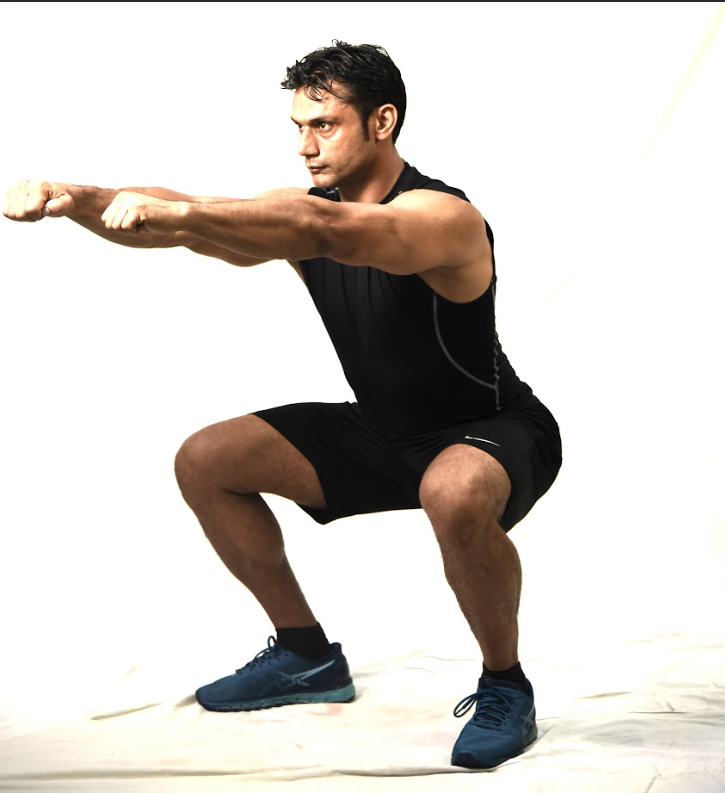
Exploring the Optimal Exercise for Building Strength, Power, and Agility: A Comparative Study on Squats and Lunges with Reference to Previous Research
Introduction Squats and lunges are widely recognised as prominent exercises for enhancing muscular strength, power,…
Read · Jul 2023The Effect of Stance Width on Muscle Activation during Weighted Squatting: A Comparative Study
The Effect of Stance Width on Muscle Activation during Weighted Squatting: A Comparative Study Dated: 19th December,…
Read · Feb 2023A Comparative Study of Push and Squat Movements to Investigate the Impact of Tempo on Muscle Activation and Perceived Muscle Pump
Abstract The term “tempo,” which refers to the rate at which an exercise is performed, continues to be a contentious…
Read · Nov 2023
Empowering Your Knees: A Holistic and Biomechanical Journey Towards Lasting Relief
Introduction: Every step we take, from scaling mountain peaks to gracefully flowing through a yoga pose, relies on the…
Read · Dec 2023