Squat
A fundamental lower body compound movement that primarily targets the quadriceps, hamstrings, and glutes.
Proper Form for Squat
- Stand with feet slightly wider than hip-width apart
- Lower hips into a squat as you bend knees and keep back flat
- Continue to lower until thighs are parallel to the floor
- Push into the floor through heels to return to start
- Keep heels flat and knees aligned with second toe
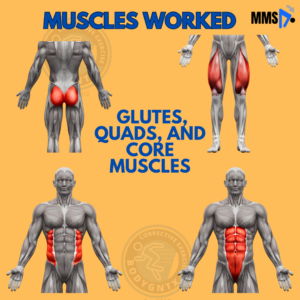
Muscles Worked: Glutes, quads, and core muscles
Basic Biomechanical Principles
The squat demonstrates several key biomechanical principles:
Force Production and Distribution
During a squat, the body must generate force to overcome gravity and the weight of the body. This force is primarily produced by the quadriceps, hamstrings, and gluteal muscles.
When performing a squat, the force applied by the feet against the ground results in an equal and opposite reaction force (Newton's Third Law). This Ground Reaction Force (GRF) travels up through the kinetic chain.
Torque and Moment Arms
Torque is calculated as the product of force and the perpendicular distance from the line of force to the axis of rotation (moment arm).
The position of the torso and knees affects the moment arms at each joint. A more vertical shin reduces the knee moment arm, while a more forward lean increases the hip moment arm.
Center of Mass and Balance
For stability during a squat, the Center of Mass (COM) must remain over the base of support (the feet). As the body descends, the COM shifts, requiring adjustments in posture to maintain balance.
Common Errors and Their Physical Consequences
Knee Valgus (Knees Collapsing Inward)
Physics Issue: Creates rotational torque at the knee joint
Consequence: Increases stress on the medial collateral ligament (MCL) and anterior cruciate ligament (ACL)
Excessive Forward Lean
Physics Issue: Shifts center of mass forward, increasing shear forces on the lumbar spine
Consequence: Greater compressive and shear forces on the intervertebral discs
Heels Rising
Physics Issue: Reduces base of support and shifts weight distribution
Consequence: Decreases stability and increases knee torque relative to hip torque
Insufficient Depth
Physics Issue: Limits range of motion and muscle activation
Consequence: Reduces work done and limits training stimulus